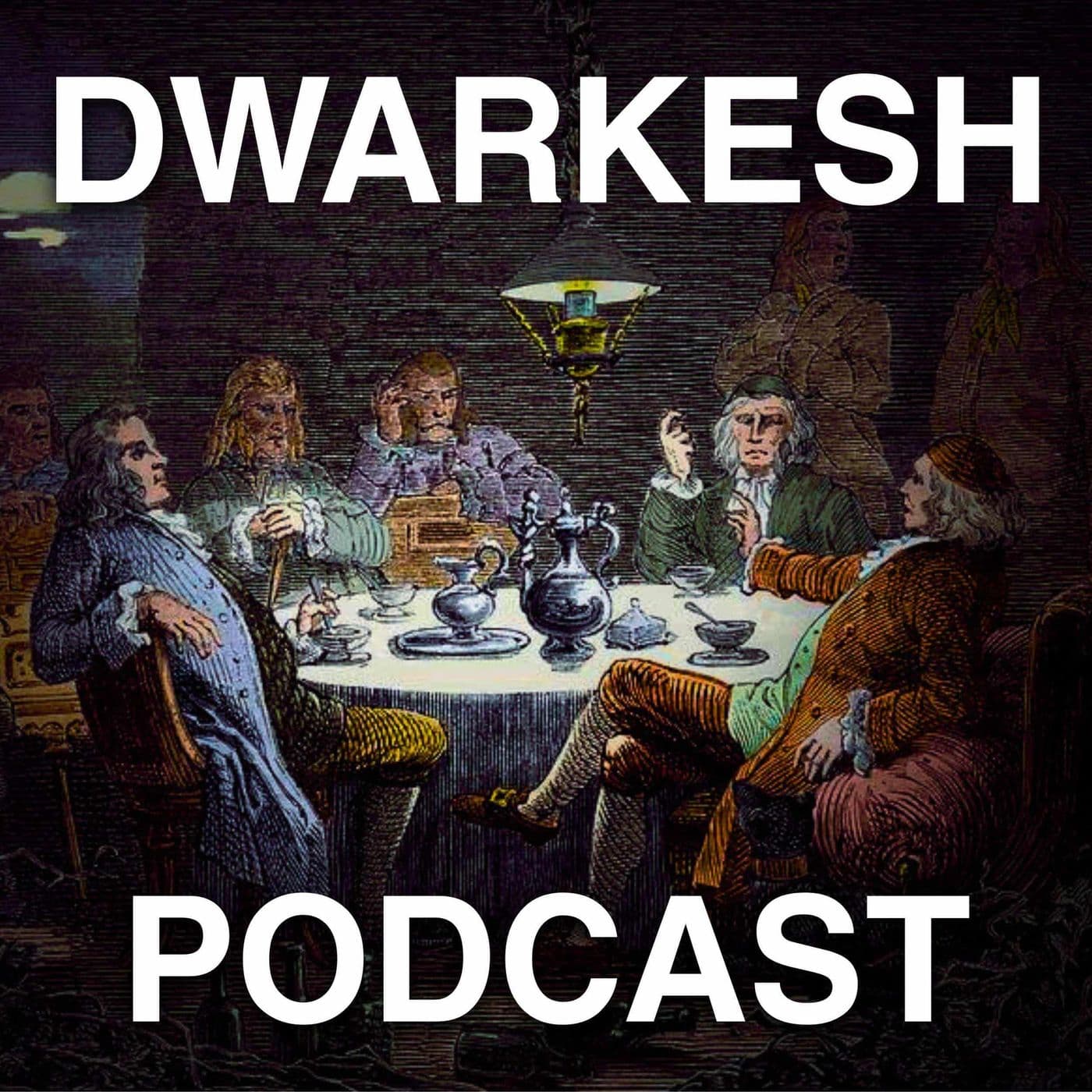
Will MacAskill - Longtermism, Altruism, History, & Technology
Descripción del Episodio
Will MacAskill is one of the founders of the Effective Altruist movement and the author of the upcoming book, What We Owe The Future.
We talk about improving the future, risk of extinction & collapse, technological & moral change, problems of academia, who changes history, and much more.
Watch on YouTube. Listen on Apple Podcasts, Spotify, or any other podcast platform.
Episode website + Transcript here.
Follow Will on Twitter. Follow me on Twitter for updates on future episodes.
Subscribe to find out about future episodes!
Timestamps
(00:23) - Effective Altruism and Western values
(07:47) - The contingency of technology
(12:02) - Who changes history?
(18:00) - Longtermist institutional reform
(25:56) - Are companies longtermist?
(28:57) - Living in an era of plasticity
(34:52) - How good can the future be?
(39:18) - Contra Tyler Cowen on what’s most important
(45:36) - AI and the centralization of power
(51:34) - The problems with academia
Please share if you enjoyed this episode! Helps out a ton!
Transcript
Dwarkesh Patel 0:06
Okay, today I have the pleasure of interviewing William MacAskill. Will is one of the founders of the Effective Altruism movement, and most recently, the author of the upcoming book, What We Owe The Future. Will, thanks for coming on the podcast.
Will MacAskill 0:20
Thanks so much for having me on.
Effective Altruism and Western values
Dwarkesh Patel 0:23
My first question is: What is the high-level explanation for the success of the Effective Altruism movement? Is it itself an example of the contingencies you talk about in the book?
Will MacAskill 0:32
Yeah, I think it is contingent. Maybe not on the order of, “this would never have happened,” but at least on the order of decades. Evidence that Effective Altruism is somewhat contingent is that similar ideas have been promoted many times during history, and not taken on.
We can go back to ancient China, the Mohists defended an impartial view of morality, and took very strategic actions to help all people. In particular, providing defensive assistance to cities under siege. Then, there were early utilitarians. Effective Altruism is broader than utilitarianism, but has some similarities. Even Peter Singer in the 70s had been promoting the idea that we should be giving most of our income to help the very poor — and didn’t get a lot of traction until early 2010 after GiveWell and Giving What We Can launched.
What explains the rise of it? I think it was a good idea waiting to happen. At some point, the internet helped to gather together a lot of like-minded people which wasn’t possible otherwise. There were some particularly lucky events like Alex meeting Holden and me meeting Toby that helped catalyze it at the particular time it did.
Dwarkesh Patel 1:49
If it's true, as you say, in the book, that moral values are very contingent, then shouldn't that make us suspect that modern Western values aren't that good? They're mediocre, or worse, because ex ante, you would expect to end up with a median of all the values we could have had at this point. Obviously, we'd be biased in favor of whatever values we were brought up in.
Will MacAskill 2:09
Absolutely. Taking history seriously and appreciating the contingency of values, appreciating that if the Nazis had won the World War, we would all be thinking, “wow, I'm so glad that moral progress happened the way it did, and we don't have Jewish people around anymore. What huge moral progress we had then!” That's a terrifying thought. I think it should make us take seriously the fact that we're very far away from the moral truth.
One of the lessons I draw in the book is that we should not think we're at the end of moral progress. We should not think, “Oh, we should lock in the Western values we have.” Instead, we should spend a lot of time trying to figure out what's actually morally right, so that the future is guided by the right values, rather than whichever happened to win out.
Dwarkesh Patel 2:56
So that makes a lot of sense. But I'm asking a slightly separate question—not only are there possible values that could be better than ours, but should we expect our values - we have the sense that we've made moral progress (things are better than they were before or better than most possible other worlds in 2100 or 2200)- should we not expect that to be the case? Should our priors be that these are ‘meh’ values?
Will MacAskill 3:19
Our priors should be that our values are as good as expected on average. Then you can make an assessment like, “Are other values of today going particularly well?” There are some arguments you could make for saying no. Perhaps if the Industrial Revolution happened in India, rather than in Western Europe, then perhaps we wouldn't have wide-scale factory farming—which I think is a moral atrocity. Having said that, my view is to think that we're doing better than average.
If civilization were just a redraw, then things would look worse in terms of our moral beliefs and attitudes. The abolition of slavery, the feminist movement, liberalism itself, democracy—these are all things that we could have lost and are huge gains.
Dwarkesh Patel 4:14
If that's true, does that make the prospect of a long reflection dangerous? If moral progress is a random walk, and we've ended up with a lucky lottery, then you're possibly reversing. Maybe you're risking regression to the mean if you just have 1,000 years of progress.
Will MacAskill 4:30
Moral progress isn't a random walk in general. There are many forces that act on culture and on what people believe. One of them is, “What’s right, morally speaking? What's their best arguments support?” I think it's a weak force, unfortunately.
The idea of lumbar flexion is getting society into a state that before we take any drastic actions that might lock in a particular set of values, we allow this force of reason and empathy and debate and goodhearted model inquiry to guide which values we end up with.
Are we unwise?
Dwarkesh Patel 5:05
In the book, you make this interesting analogy where humans at this point in history are like teenagers. But another common impression that people have of teenagers is that they disregard wisdom and tradition and the opinions of adults too early and too often. And so, do you think it makes sense to extend the analogy this way, and suggest that we should be Burkean Longtermists and reject these inside-view esoteric threats?
Will MacAskill 5:32
My view goes the opposite of the Burkean view. We are cultural creatures in our nature, and are very inclined to agree with what other people think even if we don't understand the underlying mechanisms. It works well in a low-change environment. The environment we evolved towards didn't change very much. We were hunter-gatherers for hundreds of years.
Now, we're in this period of enormous change, where the economy is doubling every 20 years, new technologies arrive every single year. That's unprecedented. It means that we should be trying to figure things out from first principles.
Dwarkesh Patel 6:34
But at current margins, do you think that's still the case? If a lot of EA and longtermist thought is first principles, do you think that more history would be better than the marginal first-principles thinker?
Will MacAskill 6:47
Two things. If it's about an understanding of history, then I'd love EA to have a better historical understanding. The most important subject if you want to do good in the world is philosophy of economics. But we've got that in abundance compared to there being very little historical knowledge in the EA community.
Should there be even more first-principles thinking? First-principles thinking paid off pretty well in the course of the Coronavirus pandemic. From January 2020, my Facebook wall was completely saturated with people freaking out, or taking it very seriously in a way that the existing institutions weren't. The existing institutions weren't properly updating to a new environment and new evidence.
The contingency of technology
Dwarkesh Patel 7:47
In your book, you point out several examples of societies tha
Episodios Recientes
Más podcasts de Sociedad y Cultura
Ver toda la categoría →Hidden History with Dr. Harini Bhat
By shows
Some questions don't have answers. Yet.Dr. Harini Bhat is a clinical pharmacist and science storyteller obsessed with questions that don't have answers. Every week she unravels real events from history that still can't be fully explained. Mass hysterias. Medical oddities. Vanished civilizations. Strange signals. Unexplained phenomena that keep repeating, centuries apart, as if history is trying to tell us something.Hidden History doesn't dismiss ancient events as myth or superstition. It treats them as incomplete case files, shaped by the limits of knowledge, technology, and record-keeping. Because the unknown isn't a failure of explanation. It's a constant in human experience, one that evolves, repeats, and sometimes deepens the more we learn.Hidden History is a Rewind Original, powered by PAVE Studios. Listen on Apple Podcasts, Spotify, or watch on YouTube @hiddenhistorypod. For more, follow @RewindStudios on Instagram.
Expedientes del más allá
By shows
Expedientes del más allá, es un viaje a través de seis historias llenas de tragedia, de misterio y de oscuridad. Dos periodistas recorren algunos de los lugares más encantados de nuestro país, viviendo los sucesos extraños que allí se producen y hablando con los protagonistas de unos fenómenos que marcaron sus vidas para siempre. Porque si el más allá existe, a veces se manifiesta de manera poco amable...

Skin in the Game
By shows
El podcast de inversiones donde los hosts tienen capital real en juego en lo que dicen. Javier Morodo, Miguel Olea, Allan Cassis y Jorge Combe revelan cada semana qué están haciendo con su dinero, en respuesta a los temas más relevantes de la coyuntura global. Inversiones reales, capital privado, venture, deuda, real estate, tecnología de frontera y geopolítica. Desde la perspectiva de quienes operan, no de quienes analizan. 📌 Nuevo episodio cada jueves a las 6am CDMX. Las opiniones son gratis. El portafolio no miente.
Dr. Death
By shows
<p>Dr. John Schneider rode into town like a character out of a Western: an outsider on a Harley-Davidson, in trademark cowboy boots. He promised relief to patients suffering in Wyoming and Montana. He seemed like the hero they needed. But when surgeries go wrong and a strange letter exposes a bitter feud, medical professionals and government officials search for the truth about this cowboy doctor. They discover claims of broken bodies, bullying, fraud, and lawsuits.</p><p><br></p><p>From Audible, the fifth season of the hit series <em>Dr. Death</em> returns with <em>The Cowboy</em>: the story of a surgeon who took advantage of a broken system and the fight to bring him to justice.</p><p><br></p><p><strong>Season 4: </strong>When a charismatic young doctor announces revolutionary treatments for cancer and HIV, patients from around the world turn to him for their last chance. As medical experts praise Serhat Gumrukcu’s genius, the company he co-founded rockets in value to over half a billion dollars. But when a team of researchers makes a startling discovery, they begin to suspect the brilliant doctor is hiding a secret.</p><p><strong>Season 3:</strong> Paolo is a smart and handsome surgeon, renowned for his ability to perform surgeries that transform his patients’ lives. When television producer Benita covers him for a story, he’ll transform her life too, but not in the ways she expects. As Benita crosses professional lines to be with him, she learns how far Paolo will go to protect his secrets. And halfway around the world, four doctors at a prestigious medical institute make shocking discoveries of their own that call everything into question.</p><p><strong>Season 2:</strong> If someone you love is diagnosed with cancer you want them to get the best treatment from the best doctors. In 2013, patients in Michigan thought Farid Fata was that doctor. Between his prestigious education, years of experience and pleasant bedside manner, Fata was everything you could want in a doctor. But he was not who he appeared to be. This is the story of hundreds of patients in Michigan, a doctor, and a poisonous secret.</p><p><strong>Season 1: </strong>We’re at our most vulnerable when we go to our doctors. We trust the person at the other end of that scalpel. We trust the hospital. We trust the system. Christopher Duntsch was a neurosurgeon who radiated confidence. He claimed he was the best in Dallas. If you had back pain, and had tried everything else, Dr. Duntsch could give you the spine surgery that would take your pain away. But soon his patients started to experience complications, and the system failed to protect them. Which begs the question: who - or what - is that system meant to protect? Dr. Death is a story about a charming surgeon, 33 patients and a spineless system.</p><p><br></p><p>Audible subscribers can listen to all episodes of <strong>Dr. Death</strong> ad-free right now. Join Audible today by downloading the Audible app.</p><p><br></p>

Mentes Imparables. Mejores Personas, mejor planeta.
By shows
Este es un espacio para conversar sin filtros, sin zapatos y con fundamento, con personas creativas, disruptivas, científicas y curiosas. Personas con mentes maravillosas que nos inspiran a ser IMPARABLES. Porque nuestra mente crea nuestra realidad. Soy Sara Mesa, médica neurorradióloga, Autora de cuatro libros y creadora de @drasaramesa. Para más información visita la página www.doctorasaramesa.com y @drasaramesa Para ver los episodios puedes ir también a mi canal de youtube https://www.youtube.com/@drasaramesa/videos

Ojalá lo hubiera sabido antes
By shows
¿Cuántas cosas nos hubieran cambiado la vida si las hubiéramos sabido antes? Esta es la expresión que a menudo nos dicen las personas cuando leen algún libro del maestro Antoni Bolinches, Francesc Miralles o Álex Rovira: “Ojalá lo hubiera sabido antes”. O las que se repiten ellos mismos cuando, a su vez, leen o escuchan a otras maestras y maestros. Muchas veces nos cuentan cosas que nos abren la cabeza y el corazón y pensamos “ojalá lo hubiera sabido antes, mi vida hubiera cambiado”. Este es un espacio en el que nos encontraremos cada semana con un nuevo episodio para compartir reflexiones

Seis de Copas
By shows
Plática entre amigas. <hr><p style='color:grey; font-size:0.75em;'> Hosted on Acast. See <a style='color:grey;' target='_blank' rel='noopener noreferrer' href='https://acast.com/privacy'>acast.com/privacy</a> for more information.</p>

Grandes Infelices
By shows
"GRANDES INFELICES. Luces y sombras de grandes novelistas" es un podcast literario de Blackie Books presentado y dirigido por el escritor Javier Peña (autor de los libros “Agnes” e “Infelices”).Javier Peña repasará capítulo a capítulo la vida y obra de destacados escritores y escritoras, que a veces tuvieron vida de novela, pero no siempre de las felices.<hr><p style='color:grey; font-size:0.75em;'> Hosted on Acast. See <a style='color:grey;' target='_blank' rel='noopener noreferrer' href='https://acast.com/privacy'>acast.com/privacy</a> for more information.</p>